Changes in breast appearance or sensation can understandably lead to concern, especially for individuals who have previously undergone breast augmentation or reconstructive surgery. While such changes may be related to benign causes, one potential issue that should be investigated is a breast implant rupture. Although often not urgent, implant rupture should be assessed and managed by a qualified medical professional.
Dr. Robert Owen, a Specialist Plastic & Reconstructive Surgeon based in Perth, WA, has significant clinical experience in breast implant surgery, including revision and complex reconstructive procedures. His patient-centred approach places importance on clear diagnosis, individualised planning, and evidence-based care, providing patients with informed support throughout their care.
This article explores what a ruptured breast implant is, how to recognise potential signs, what happens during assessment, and what treatment options may be suitable. It also outlines how Dr. Owen’s practice in Perth provides comprehensive care for individuals navigating these concerns.
What is a Breast Implant Rupture?
– Understanding Implant Integrity
Breast implant rupture refers to the failure or breach of the implant’s outer shell. This allows the internal filling material – either sterile saline or silicone gel – to escape from the implant body.
With saline implants, the rupture is typically easy to identify. The body safely absorbs the leaked fluid over days or weeks, leading to a visible decrease in breast volume and firmness.
In contrast, silicone implants contain a cohesive gel that tends to remain within the fibrous capsule surrounding the implant, even after rupture. This results in a “silent rupture,” which may not cause immediate changes in shape or size and is often detected only through imaging studies such as MRI or ultrasound.
While the rupture itself is usually not dangerous, it is important to understand the implications and discuss ongoing options with a qualified surgeon.
– Why It Happens?
There are several reasons a breast implant may rupture. These factors can vary based on implant type, placement, surgical technique, and patient history.
Age of the implant is one of the most common contributors. Over time, the implant shell may degrade due to wear and pressure. Most implants are not designed to last a lifetime and may need replacement after 10 to 15 years.
Physical trauma such as a fall, direct impact, or car accident may compromise the integrity of the implant, even years after the original surgery.
Surgical factors, including how the implant pocket was created or how the implant was inserted, may also play a role in long-term durability.
Manufacturing defects, while rare, have occurred in the past and may lead to premature failure of the implant shell.
Capsular contracture, a condition where the body forms firm scar tissue around the implant, may place pressure on the implant over time and increase the risk of rupture.
Signs That May Suggest a Rupture
Patients with a ruptured implant may experience a range of symptoms – or no symptoms at all. Recognising potential signs is important for early diagnosis and management.
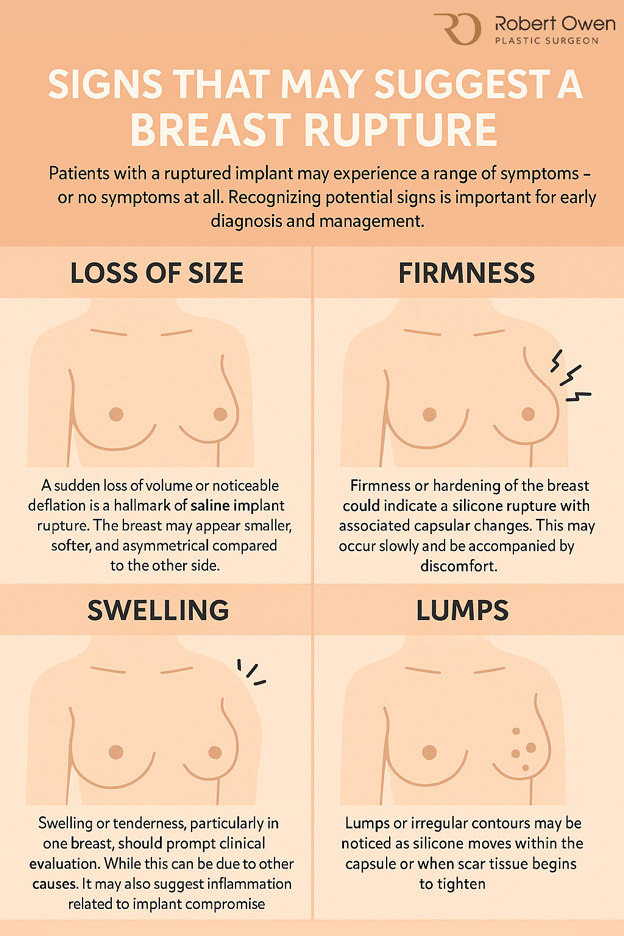
- A sudden loss of volume or noticeable deflation is a hallmark of saline implant rupture. The breast may appear smaller, softer, and asymmetrical compared to the other side.
- Firmness or hardening of the breast could indicate a silicone rupture with associated capsular changes. This may occur slowly and be accompanied by discomfort.
- Swelling or tenderness, particularly in one breast, should prompt clinical evaluation. While this can be due to other causes, it may also suggest inflammation related to implant compromise.
- Lumps or irregular contours may be noticed as silicone moves within the capsule or when scar tissue begins to tighten.
In many silicone implant ruptures, there are no visible or physical symptoms, making routine monitoring important, particularly for older implants.
If you notice any of these signs – or even if you’re unsure – it’s advisable to consult a qualified surgeon such as Dr. Robert Owen for a professional evaluation in Perth.
Clinical Evaluation with Dr. Robert Owen
When to Seek an Expert Opinion
Not all breast changes are due to implant rupture, but any new or unusual symptoms should be assessed. Early evaluation allows for more treatment options and may reduce the risk of further complications.
Patients in Perth and surrounding regions can request a referral from their GP to see Dr. Robert Owen, who has experience in breast implant assessment and surgery. His practice provides a private clinical setting where discussions are conducted respectfully and confidentially.
Whether you’re experiencing obvious symptoms or simply wish to confirm implant integrity, scheduling a consultation ensures your concerns are reviewed within a clinical framework.
What to Expect During Your Consultation
Your first appointment with Dr. Owen is designed to be clinically focused and respectful. He will:
- Take a detailed medical and surgical history, including information about your original breast augmentation, the type and brand of implants used, and any previous complications or revisions.
- Perform a focused breast examination, assessing implant position, texture, symmetry, and any visible or palpable changes.
- Discuss your symptoms and concerns, giving you space to ask questions and describe what you’ve noticed.
- Recommend imaging if needed, particularly for silicone implants where physical symptoms may be absent.
Outline potential next steps, including surgical and non-surgical options, and help you understand the benefits, limitations, and likely outcomes of each.
Surgical Options and Individualised Planning
Removal vs Replacement – What’s Right for You?
If a ruptured implant is confirmed, Dr. Owen will guide you through the decision-making process for managing it. Treatment options are based on your preferences, anatomical features, and clinical needs.
Implant removal (explantation) may be chosen by patients who no longer wish to have implants. This option may include reshaping the remaining tissue or performing a breast lift.
Implant removal and replacement is suitable for patients who wish to maintain or adjust their breast volume. This may involve choosing new implants based on current preferences or body proportions.
Additional procedures may include fat grafting, mastopexy, or revision of the implant pocket. These techniques are selectively used depending on clinical findings and patient preferences.
Dr. Owen discusses each of these options in detail, supporting decision-making with current clinical information.
How Dr. Owen Plans Surgery Based on Your Needs
Every patient presents with a unique combination of anatomy, surgical history, and preferences.
He takes into account:
- Breast dimensions, skin elasticity, and tissue thickness
- Previous incisions or scarring
- Desired outcomes, such as upper pole volume or improved proportion
Surgical techniques are tailored and evidence-based. Dr. Owen may use:
- Keller Funnel insertion sleeves to reduce implant handling
- Precise implant pocket dissection to support stable positioning
- Acellular dermal matrix (ADM) when indicated for additional support
- Fat grafting to enhance soft tissue coverage where appropriate
What the Surgical Process Involves
✓ Pre-Operative Preparation
Preparation begins with clear communication. Once a surgical plan is confirmed, patients receive an individualised pre-operative protocol.
This includes:
- Education about the planned procedure and what to expect afterward
- Pre-surgery screening and tests
- Post-operative care guidance and activity recommendations
✓ The Procedure
Surgical steps may include:
- Re-entering through existing incisions when possible
- Removal of the ruptured implant and capsule if necessary
- Insertion of a new implant, if part of the plan
- Adjunct procedures such as fat transfer or mastopexy when indicated
Dr. Owen aims to support tissue health and positioning through careful technique and evidence-based surgical planning.
✓ Recovery and Post-Operative Support
Recovery typically involves:
- Wearing a soft, supportive, front-fastening surgical bra for six weeks
- Gentle walking after two weeks to support circulation
- Avoiding strenuous activity for six weeks
- Attending follow-ups to monitor healing and address any concerns
Written instructions and follow-up contact details are provided to support patients during recovery.
Risks and Considerations
✓ What Patients Should Know
All surgical procedures carry risks. Considerations for implant revision surgery may include:
- Bleeding, infection, or delayed healing
- Scarring
- Residual asymmetry
- Sensory changes
- The potential for future procedures
Understanding these possibilities supports informed decision-making.
✓ How Dr. Owen Minimises Risks
Dr. Owen applies evidence-based measures to reduce risks, including:
- Strict sterility protocols and limited implant handling
- Control of bleeding during surgery
- Use of drains when indicated
- Clear patient education regarding recovery and warning signs
His approach focuses on structured follow-up and long-term clinical outcomes.
FAQs About Understanding Ruptured Breast Implants
Why Choose Dr. Robert Owen in Perth
✓ Care by a Qualified Specialist Plastic & Reconstructive Surgeon
Dr. Robert Owen is a Specialist Plastic & Reconstructive Surgeon with a focus on breast surgery, including revision procedures. He provides clinical care that is guided by integrity, accountability, and evidence-based decision-making.
✓ A Perth-Based Practice Focused on Patient Care
Dr. Owen’s clinic in Perth, WA offers a comprehensive environment for breast surgery assessment and care. Working with a dedicated team, the practice supports patients through consultation, surgery, and recovery.
Next Steps
If you are concerned about a ruptured breast implant, or wish to review the condition of your implants, speak with your GP about a referral to Dr. Robert Owen.
For further information, visit www.drrobertowen.com.au.
Disclaimer: This article is for general informational purposes only and should not be considered medical advice. Individuals should consult their GP or a Specialist Plastic Surgeon to assess personal suitability and treatment options.
Further Reading about Ruptured Breast Implant
- Read more about Dr Robert Owen’s Procedure Page on Breast Implant Removal Perth
- Read more about Dr Robert Owen’s Procedure Page on Breast Implant Replacement Perth
- Read more about Dr Robert Owen’s Procedure Page on Breast Lift with Implants (Mastopexy Augmentation)