Dr Robert Owen is a Specialist Plastic & Reconstructive Surgeon based in Perth, WA. Over the past decade, he has seen an increasing number of patients seeking information about the long-term implications of breast implants. Whether inserted for cosmetic or reconstructive purposes, breast implants are not lifetime devices, and understanding what happens to them – and your body – over time is crucial to maintaining both aesthetic and medical health.
This article outlines the potential outcomes of leaving breast implants in too long, the signs of ageing implants, associated risks, and the options available to patients. With a patient-first, evidence-based approach, Dr Owen focuses on providing honest, realistic guidance to help patients make informed decisions about their long-term care.
Understanding the Lifespan of Breast Implants
Breast implants, whether saline or silicone, are not designed to last forever. While some patients may have implants for 10 – 20 years without issues, most manufacturers and regulatory bodies, such as the Therapeutic Goods Administration (TGA) and the U.S. Food and Drug Administration (FDA), suggest that implants typically last 10 to 15 years before requiring assessment for potential breast implant replacement or removal.
Even if a patient is symptom-free, implants may be silently degrading over time. Unlike mechanical devices that show visible wear, breast implants may fail gradually and silently, particularly in the case of silicone implants. For this reason, routine monitoring becomes increasingly important the older the implants are.
The idea that “if it’s not broken, don’t fix it” doesn’t always apply. Waiting until a complication occurs – such as rupture, capsular contracture, or discomfort – can make revision surgery more complex and recovery more difficult.
What Happens to Implants Inside the Body Over Time
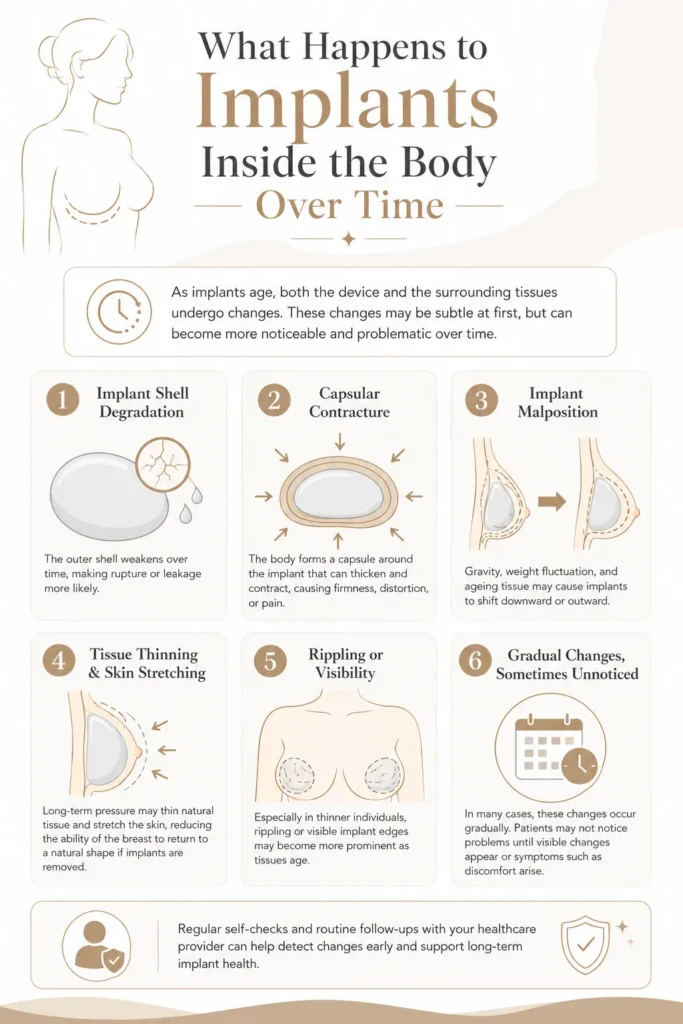
As implants age, both the device and the surrounding tissues undergo changes. These changes may be subtle at first, but can become more noticeable and problematic over time.
- Implant shell degradation: The outer shell of both saline and silicone implants weakens over time, making rupture or leakage more likely.
- Capsular contracture: The body forms a capsule around every implant. Over time, this capsule can become thickened and contract, causing firmness, distortion, or pain.
- Implant malposition: Gravity, weight fluctuation, and ageing tissue may cause implants to shift downward or outward.
- Tissue thinning and skin stretching: Long-term pressure from implants may thin natural breast tissue and stretch the skin, reducing the ability of the breast to return to a natural shape if the implants are removed.
- Rippling or visibility: Especially in thinner individuals, rippling or visible implant edges may become more prominent as tissues age.
In many cases, these changes occur gradually. Patients may not notice problems until visible changes appear or symptoms such as discomfort arise.
Medical Complications of Long-Term Implants
Leaving implants in beyond their intended lifespan increases the risk of complications. Some of these complications may require surgical intervention, and others can impact health or diagnostic procedures.
- Capsular contracture: This occurs when the capsule tightens around the implant, potentially causing distortion, pain, and firmness. It can happen at any time but becomes more common with ageing implants.
- Implant rupture: Saline ruptures are usually noticeable quickly, as the breast deflates. Silicone ruptures are often “silent,” with no visible signs. These are only detected via imaging such as MRI or ultrasound.
- Calcification and hardening: Over time, the capsule can calcify, making it harder and more difficult to remove if needed.
- Chronic pain: Nerve sensitivity or discomfort may develop due to changes in implant position or capsular tension.
- BIA-ALCL (Breast Implant-Associated Anaplastic Large Cell Lymphoma): Although rare, this cancer has been associated primarily with textured implants and typically develops 8 – 10 years post-implantation. Symptoms include swelling, lumps, or fluid accumulation.
- Extrusion risk: In rare cases, very old or ruptured implants can begin to erode toward the skin, risking exposure or infection.
- Mammogram interference: Implants may obscure parts of the breast on mammograms, making cancer screening more difficult, especially when capsular contracture or rupture is present.
Take Surgery Quiz
Systemic Symptoms and Breast Implant Illness (BII)
A growing number of women report systemic symptoms they believe are linked to their breast implants. This collection of symptoms has been termed Breast Implant Illness (BII). While BII is not formally recognised as a diagnosable condition, many patients describe improvements in symptoms after implant removal.
Common BII symptoms include:
- Fatigue
- Brain fog
- Joint and muscle pain
- Rashes or skin irritation
- Hair thinning
- Anxiety or mood changes
Dr Owen approaches these concerns respectfully and thoroughly. While no guarantees are made regarding symptom resolution, he acknowledges that some patients report significant improvements after explantation, particularly when implants have been in place for many years or complications such as rupture are present.
How to Monitor Ageing Implants
Patients with breast implants should have a regular check-up every few years, even in the absence of symptoms. After 10 years, yearly reviews are recommended.
Dr Owen advises the following monitoring steps:
- Know your implant age: Understand when your surgery was performed and what type of implant was used.
- Clinical review: A physical exam with a Specialist Plastic Surgeon can help detect early signs of capsular contracture or asymmetry.
- Imaging: Ultrasound can detect fluid, rupture, or capsule thickening. MRI is more sensitive for detecting silent silicone ruptures.
- Self-awareness: Monitor for changes in breast shape, discomfort, or new symptoms such as swelling, pain, or lumps.
If you’re unsure how old your implants are or if your surgical records are unavailable, a consultation can help establish a monitoring plan.
Dr Owen’s Surgical Philosophy on Long-Term Implants
Dr Owen takes a measured and medically guided approach to breast implant management. He does not encourage unnecessary procedures but also does not advise patients to ignore signs that implants may be ageing or deteriorating.
His process includes:
- In-depth consultation: Reviewing the patient’s symptoms, medical history, implant age, and surgical goals.
- Honest discussion: Explaining the risks of leaving implants in too long and what alternatives exist.
- Imaging when indicated: Referrals for ultrasound or MRI to assess implant integrity.
- Collaborative planning: Whether removal, replacement, or continued observation is best, the decision is made with patient input and medical evidence.
What Are Your Options If You’ve Had Implants for 10+ Years?
Every patient is different, but the longer implants are in place, the more important it becomes to have a clear plan. Dr Owen generally outlines three main options:
✓ Continue Monitoring
If there are no signs of complications and imaging confirms the implants are intact, continued observation may be appropriate. This approach is suitable for patients who are asymptomatic and understand the need for routine follow-up. Dr Owen typically recommends annual reviews and imaging after the 10-year mark. Monitoring should include clinical exams and, when indicated, ultrasound or MRI.
✓ Replace the Implants
For patients who wish to maintain breast volume and implant aesthetics, replacing the implants may be a practical solution. This is often combined with capsulectomy or adjustment of the implant pocket to correct positioning. Modern implants may offer improved materials and design, potentially reducing future complications. Breast implant replacement is most appropriate when the patient is otherwise satisfied with having implants long-term.
✓ Remove Implants Without Replacement
Explantation without replacing the implants is a common choice for those experiencing discomfort, systemic symptoms, or a change in body preferences. In these cases, Dr Owen may recommend procedures such as mastopexy (breast lift) or fat grafting to improve contour and proportion. This approach avoids the need for ongoing implant surveillance or future revision surgery. It may also appeal to patients seeking a more natural or low-maintenance outcome.
Implant Longevity and Safety Timeline FAQs
Why Choose Dr Robert Owen for Ensuring Implant Management?
Dr Owen is a fully qualified Specialist Plastic & Reconstructive Surgeon who has helped many women manage ageing breast implants. Whether addressing complications or supporting aesthetic goals, he provides honest, evidence-based advice and skilled surgical care.
His background in both cosmetic and reconstructive surgery means he can offer comprehensive solutions, including:
- Implant exchange
- Explant with mastopexy or fat grafting
- Complex revision surgery
Dr Owen is known for his ethical practice and collaborative patient care. He doesn’t promote unnecessary surgery and provides individualised recommendations tailored to each patient’s needs.
Dos and Don’ts for Long-Term Implant Health
✅ Do:
- Know the age and type of your implants
- Schedule regular reviews with your plastic surgeon
- Get imaging (MRI or ultrasound) if your implants are over 10 years old
- Be aware of new symptoms and seek advice promptly
- Discuss all your options before making a decision
❌ Don’t:
- Ignore changes in breast shape or sensation
- Delay evaluation for unexplained pain, swelling, or firmness
- Assume no symptoms means no issue
- Compare your outcome to others without expert assessment
- Let fear or misinformation prevent timely care
Next Steps – Considering Your Options
If you’ve had implants in place for more than 10 years or are noticing changes in your breasts, it’s a good time to seek a consultation. Dr Owen can help assess your implant status and guide you through the available options, whether that means monitoring, replacing, or removing your implants.
📍 Perth, Western Australia
🌐 Visit www.drrobertowen.com.au for more information or to book a private consultation.
Further Reading
- Read more about Breast Implant Removal
- Read more about Breast Implant Replacement Perth
- Read Dr Owen’s Blog on What is an Enbloc Removal?
- Read Dr Owen’s Blog on Options After Removing Breast Implants
- Read Dr Owen’s Blog on Do I Have a Ruptured Breast Implant?